
EXPLORE AUTOMATION PARTS

GET TECHNICAL REPAIR QUOTE

CONTACT US NOW

WHATSAPP NOW
/resources-hub/hvac-control-panel/
HVAC systems across the UAE run harder and longer than almost anywhere else in the world. This article explains how HVAC control panels improve efficiency, reliability, and building automation.
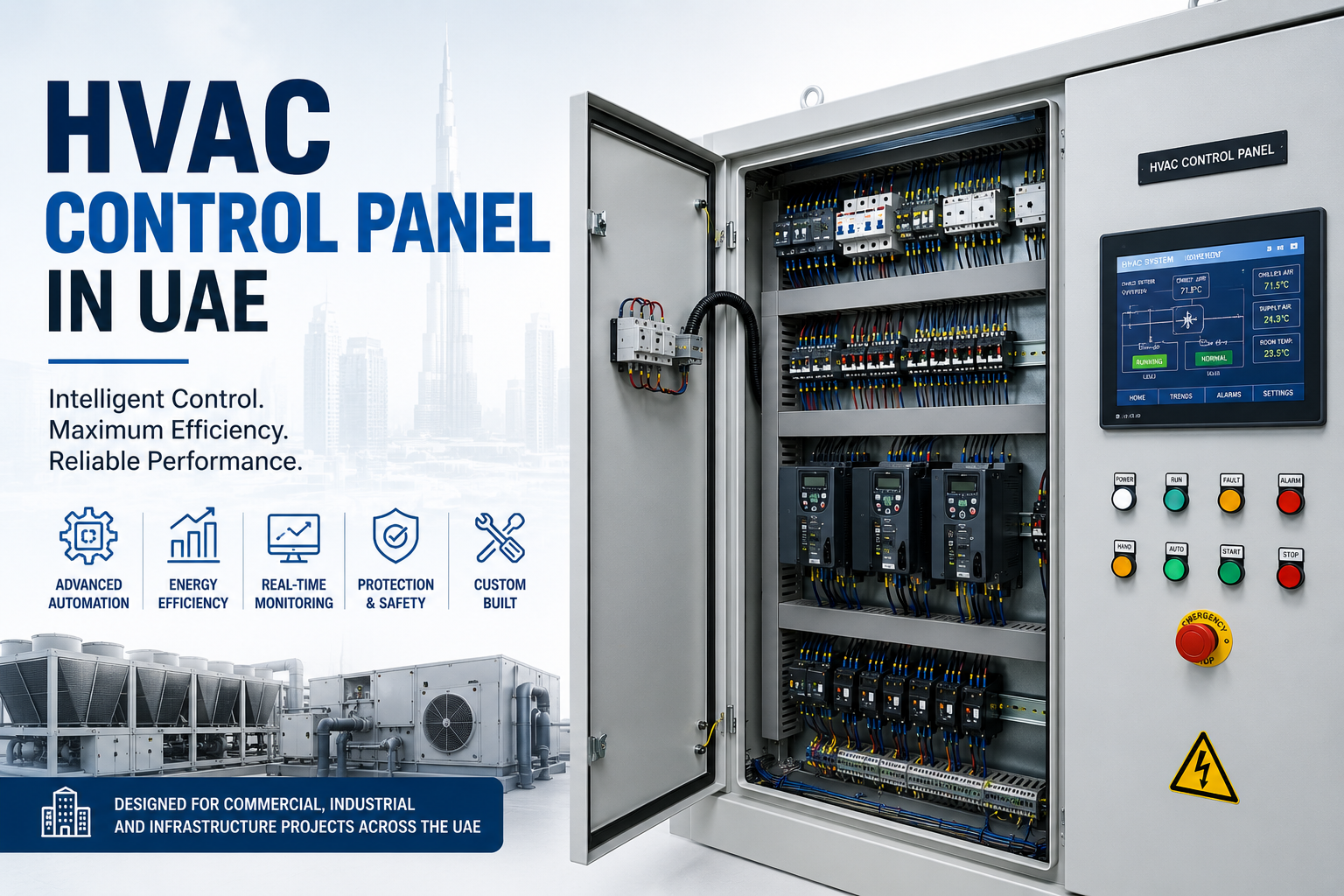
Anyone who has stood on a Dubai rooftop in August knows what an HVAC system is up against. Chillers, air handling units, fan coil units and ventilation fans are doing more continuous, heavier work here than almost anywhere else in the world, often for ten or eleven months of the year rather than a single summer season. The equipment that keeps these systems coordinated, protected and efficient is the HVAC control panel and in a market where cooling can account for a large share of a building's entire energy bill, the panel behind it has a direct effect on operating cost, equipment lifespan and occupant comfort.
Epoch International designs, builds and supports HVAC control panels for commercial, industrial and infrastructure projects across the UAE, from new-build plant rooms to retrofits on ageing systems that were never built to talk to a BMS. This page covers what we deliver, the kinds of projects and industries we work in, and how a typical project runs from first site visit to commissioning.
An HVAC control panel is the electrical and automation enclosure that coordinates the mechanical equipment in a heating, ventilation and air conditioning system — chillers, pumps, fans and dampers — so they operate as one sequenced system rather than independently. It sequences equipment on and off in the right order, regulates output to match real-time demand instead of running everything at full capacity, and protects connected motors from electrical faults and unsafe operating conditions.
Most panels we build also interface with a building management system (BMS), giving facilities teams a single point from which to monitor temperatures, pressures, run hours, faults and energy consumption across the entire mechanical plant, instead of checking individual units floor by floor.
A panel typically manages some combination of chillers and chilled water plant, air handling units, fan coil units or VRF systems, cooling tower fans, circulation pumps, and ventilation or smoke extraction fans — often across several panels working together on larger sites, all reporting back to one BMS architecture.
We work on the full range of HVAC control panel projects rather than a single fixed product, because plant rooms, building age and BMS requirements vary widely from one site to the next. Typical project types include:
For new developments, we design and build control panels around the mechanical contractor's chiller, pump and AHU selection from the outset — including sequencing logic for multiple-chiller staging built around a PLC and HMI control architecture, VFD selection for pumps and fans, and BMS protocol mapping so the panel is ready to integrate the day the building is commissioned, rather than being adapted afterwards.
A large share of our HVAC panel work is retrofitting older plant rooms — replacing failing relays, contactors and obsolete controllers, adding VFDs to motors that have run at fixed speed for years, or rebuilding sequencing logic around equipment that has been added to a system piecemeal over time. We work around live buildings wherever possible, scheduling panel changeovers to minimise disruption to occupied spaces.
Many buildings in the UAE were commissioned before centralised BMS platforms were standard, or have a BMS that doesn't cover the HVAC plant fully. We retrofit HVAC control panels with the communication hardware and protocol mapping (BACnet, Modbus, or LonWorks) needed to bring chillers, AHUs and pumps into an existing or newly installed BMS.
For larger commercial and industrial plant rooms running two or more chillers, we build panels with sequencing logic that stages chillers based on actual load rather than running all units regardless of demand — one of the more direct ways to reduce energy cost on sites with significant chiller capacity.
For buildings with large fan coil unit counts — hotels, office towers, residential developments — we build zone-level control panels with HMI-based zone monitoring that group FCUs by floor or area, giving facilities teams zone-level visibility and control without needing to manage every unit individually.
HVAC control panel requirements differ significantly by sector, and we size our approach to the priorities of each:
Zoned comfort control and energy management across multiple floors, often with a strong focus on reducing run hours outside business hours and integrating with existing BMS platforms.
High occupancy variability and long operating hours mean cooling load can swing significantly between weekdays, weekends and peak shopping periods. Panels for these sites are typically built with wider turndown ranges and tighter sequencing logic to track that variability without wasting energy.
Strict environmental control, redundancy requirements, and integration with life-safety and smoke extraction systems. We work closely with the mechanical and fire-life-safety contractors on these projects, since HVAC control logic here has to account for failure modes that simply don't apply elsewhere.
Guest comfort alongside energy efficiency across large, varied zone counts — often combining central plant panels with zone-level FCU control to balance comfort expectations against occupancy-driven energy savings.
Process-related cooling and ventilation alongside general comfort cooling, frequently as part of broader industrial automation projects we already run on the same site — PLC-based process control, motor control panels, or power factor correction with capacitor bank panels.
Precision cooling control where reliability and redundancy take priority over almost everything else, with panel design built around N+1 or 2N redundancy depending on the facility's uptime requirements.
HVAC control panels aren't an off-the-shelf product, and we don't treat them as one. Every panel we build is sized and specified against the actual equipment, zoning and growth plans of the site. In practice, that customisation covers:
If a project calls for something outside our usual scope — an unusual protocol, a brand we haven't used before, a non-standard enclosure spec — we'll say so upfront rather than force-fitting a standard panel to a non-standard requirement.
Sustained outdoor temperatures above 45°C mean HVAC plant here runs harder and longer than in most markets, so panels need enclosure ratings (commonly IP54 or higher) suited to heat and dust, and internal protection so electronics aren't compromised by ambient conditions. Cooling also represents a substantial share of total building energy use in the UAE, which is why VFD-based modulation and demand-based sequencing tend to show up as a measurable cost line rather than a theoretical benefit. And with green building and Estidama/LEED-aligned requirements becoming more common on new developments, panels increasingly need to be BMS-ready from day one rather than retrofitted later.
Most projects, whether new-build or retrofit, follow a similar sequence:
We start with a site visit or drawing review to understand the existing or planned mechanical equipment, the BMS platform in use (if any), and any constraints — access, downtime windows, enclosure environment — that will shape the panel design.
We design the panel layout and write the sequencing logic specific to the site's equipment and load profile, including chiller staging, VFD speed control strategy, and the points list for BMS integration.
We source PLCs, VFDs, HMIs, contactors and protective devices from the brands specified for the project, drawing on our existing supply relationships across major automation manufacturers.
Panels are assembled and tested before leaving the workshop — checking wiring, logic, and communication with test signals — so issues are caught before installation rather than discovered on site.
On-site installation, point-to-point checks, and commissioning against the mechanical equipment and BMS, with sequencing logic tuned against actual running conditions rather than assumptions made at the design stage.
Once a panel is live, we provide ongoing technical support, spare parts, and modification work as buildings change — additional zones, equipment upgrades, or BMS platform changes — without needing a full panel replacement.
Because HVAC control panels are built to the specifics of each project, the provider matters as much as the components. A few things worth asking directly:
If you're scoping a new plant room, upgrading an ageing panel, or trying to get an existing HVAC system talking to a BMS it was never built for, send us the basics building type, equipment list or drawings if you have them, and your BMS platform and we'll come back with how we'd approach the panel design, sequencing logic, and a realistic timeline.
We also support the automation work that often sits alongside HVAC projects on the same site, including PLC and HMI supply, VFDs, industrial PCs, and power factor correction equipment such as capacitor bank panels.
Contact Epoch International to discuss your project.
Didn't Find What You Were Looking For?
Let Us Help You


