




Why Industrial Automation Control Systems Matter
Modern industrial facilities depend on automation systems to maintain stable operation across machines, production lines, utilities, and process environments.
Industrial control systems help manage:
- Production equipment
- Industrial communication
- Motor control systems
- Process monitoring
- Safety infrastructure
- Data collection and reporting
Without proper automation architecture, industrial facilities may experience:
- Production instability
- Communication failures
- Increased downtime
- Reduced process visibility
- Manual operational dependency
Control systems help industries improve operational efficiency while maintaining stable and scalable automation infrastructure.
What Is a PLC?
PLC stands for Programmable Logic Controller. A PLC is an industrial digital controller designed to automate machinery and industrial equipment through programmed logic execution.
PLCs are primarily used for machine-level automation where rapid operational response and control accuracy are required.
A PLC receives signals from industrial input devices such as:
- Sensors
- Push buttons
- Safety switches
- Encoders
- Limit switches
Based on programmed instructions, the PLC processes these signals and controls output devices including:
- Motors
- Relays
- Valves
- Contactors
- Industrial drives
PLCs are widely used because they provide fast processing, reliable operation, and flexible automation control across industrial environments.
Industrial Applications of PLC Systems
PLC systems are commonly integrated into:
- Conveyor automation systems
- Packaging machinery
- Industrial robotics
- Motor control systems
- Material handling equipment
- Production machinery
- Manufacturing automation systems
These systems are highly effective in industries where machine sequencing and real-time operational control are important.
A properly designed PLC system helps industries improve:
- Production consistency
- Operational response time
- Automation flexibility
- Equipment synchronization
- System scalability
Industries searching for reliable automation hardware often coordinate with a PLC Supplier in UAE to identify systems suitable for industrial process requirements and automation integration.
What Is SCADA?
SCADA stands for Supervisory Control and Data Acquisition. Unlike PLC systems that focus mainly on machine control, SCADA systems are designed for industrial monitoring, data visualization, and centralized operational supervision.
SCADA systems collect real-time operational information from:
- PLC systems
- RTUs
- Industrial sensors
- Drives
- Field devices
- Communication networks
This information is displayed through graphical interfaces that allow operators to monitor industrial processes across facilities.
SCADA platforms help industries supervise:
- Production status
- Alarm conditions
- Equipment operation
- Process trends
- Energy usage
- Operational analytics
Rather than controlling machines directly at high speed, SCADA systems focus on visibility and supervisory management across industrial infrastructure.
Applications of SCADA Systems
SCADA systems are commonly used in:
- Water treatment facilities
- Oil and gas infrastructure
- Power generation plants
- Utility systems
- Industrial processing facilities
- Smart infrastructure projects
These environments often involve distributed operations spread across large industrial areas.
SCADA systems help industries improve:
- Remote monitoring capability
- Centralized operational visibility
- Alarm management
- Historical reporting
- Data-driven maintenance planning
Modern industrial facilities increasingly depend on SCADA systems to improve operational transparency and process management.
What Is DCS?
DCS stands for Distributed Control System. DCS platforms are designed for continuous process industries where multiple automation loops operate simultaneously across interconnected systems.
Unlike PLC systems that mainly focus on machine automation, DCS systems manage complete industrial processes continuously.
DCS architecture distributes control functions across multiple controllers connected through industrial communication networks.
This structure allows industries to maintain:
- Continuous process stability
- Plant-wide automation coordination
- Redundancy and operational reliability
- Integrated process control
- Large-scale system monitoring
DCS systems are commonly implemented in process industries where uninterrupted operation is critical.
Applications of DCS Systems
DCS systems are widely used in:
- Chemical processing plants
- Oil refineries
- Pharmaceutical manufacturing
- Cement industries
- Power plants
- Food processing industries
These environments involve continuous production processes requiring stable operational coordination over long production cycles.
DCS systems are designed to improve:
- Process consistency
- Operational redundancy
- Integrated control architecture
- Large-scale automation coordination
Unlike machine-focused PLC systems, DCS platforms are optimized for process-oriented industrial environments.
Main Difference Between PLC, SCADA, and DCS
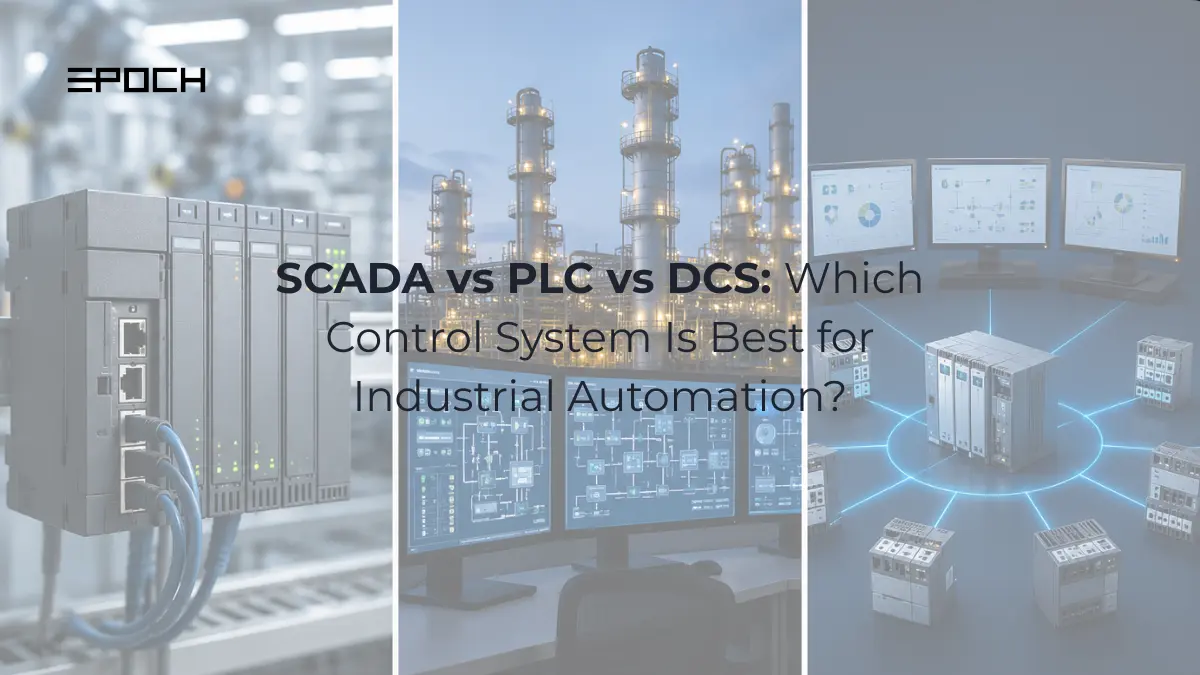
Although PLC, SCADA, and DCS systems often work together inside industrial facilities, their operational purpose differs significantly.
| System | Main Purpose | Common Industrial Use |
| PLC | Machine-level control | Manufacturing and automation equipment |
| SCADA | Monitoring and supervisory management | Utilities and distributed systems |
| DCS | Continuous process automation | Process industries and large plants |
Understanding these differences is important when selecting industrial automation infrastructure.
PLC vs DCS: Operational Comparison
PLC systems are generally preferred for:
- Fast machine control
- Standalone automation equipment
- Packaging systems
- Conveyor systems
- Robotics integration
DCS systems are better suited for:
- Continuous process environments
- Integrated plant-wide control
- High-redundancy operations
- Large industrial infrastructure
For example:
- A robotic production line typically uses PLC automation
- A refinery or power plant commonly uses DCS architecture
The operational objective determines which control system is most suitable.
How SCADA Integrates with PLC and DCS
SCADA systems are often integrated together with PLC or DCS infrastructure.
In many industrial facilities:
- PLC systems perform machine control
- DCS systems manage continuous process automation
- SCADA platforms provide centralized monitoring and visualization
This layered automation structure improves operational visibility while maintaining stable process control.
Choosing the Right Automation System
There is no single control system suitable for every industrial environment. The correct automation architecture depends on:
- Process complexity
- Industry type
- Production scale
- Monitoring requirements
- Redundancy requirements
- Communication infrastructure
PLC systems are suitable for:
- Manufacturing automation
- Machine control
- Material handling systems
- Packaging operations
SCADA systems are suitable for:
- Utility infrastructure
- Remote monitoring systems
- Operational reporting
- Supervisory management
DCS systems are suitable for:
- Continuous production processes
- Process industries
- Large industrial plants
- Integrated automation environments
Selecting the correct architecture improves operational scalability and long-term system reliability.
Common Automation Selection Mistakes
Many industrial facilities experience operational limitations because automation systems are selected without considering future scalability or process requirements.
Common mistakes include:
- Using PLC systems for large process environments
- Poor communication infrastructure planning
- Lack of redundancy in critical operations
- Improper integration between automation layers
- Inadequate industrial networking design
These issues may result in:
- Increased downtime
- Communication instability
- Reduced process visibility
- Limited future expansion capability
- Higher maintenance complexity
Proper automation planning is essential for stable industrial operation.
Industrial Automation and Industry 4.0
Modern industrial automation environments increasingly rely on connected manufacturing systems involving:
- Industrial IoT platforms
- Smart factory infrastructure
- Predictive maintenance systems
- Cloud-based monitoring
- Advanced operational analytics
PLC, SCADA, and DCS systems now support industrial communication protocols and real-time operational visibility across connected industrial environments.
This allows industries to improve process efficiency while reducing manual operational dependency.
Automation Infrastructure and Industrial Integration
Industrial automation architecture should be selected based on operational requirements rather than product popularity alone.
At Epoch International, industrial automation systems are aligned with operational scalability, communication infrastructure, process requirements, and long-term automation reliability across industrial applications.
Industries searching for integrated automation infrastructure often work with an industrial equipment supplier in Dubai to identify systems compatible with manufacturing environments, process industries, and large-scale automation projects.
Conclusion
PLC, SCADA, and DCS systems each serve different roles in industrial automation environments. PLC systems are designed for machine-level control and fast operational response. SCADA systems focus on monitoring, supervisory management, and industrial data visibility. DCS platforms are designed for continuous process automation involving integrated plant-wide operations.
Understanding the difference between these systems helps industries design automation infrastructure suitable for manufacturing plants, utilities, process industries, and industrial production environments.
Selecting the correct automation architecture improves operational reliability, scalability, process visibility, and long-term industrial performance.