
EXPLORE AUTOMATION PARTS

GET TECHNICAL REPAIR QUOTE

CONTACT US NOW

WHATSAPP NOW
/resources-hub/chiller-control-panel-uae/
Quick Answer: A chiller control panel is the electrical box that runs and protects a chiller. It starts and stops the compressor, keeps temperature and pressure at the right level, runs multiple chillers together if there's more than one, and shuts the system down safely if something goes wrong. In the UAE, where chillers run almost all year under heavy heat load, the panel has a direct effect on energy bills, equipment life, and uptime. Panels range from simple relay-based units to PLC-based systems connected to a building management system (BMS). This guide covers the main types, what's inside them, and where each one is used across UAE industries. Chiller control panels are one part of a much bigger picture — see our HVAC control panel guide if you're looking at the whole plant room rather than just the chiller.
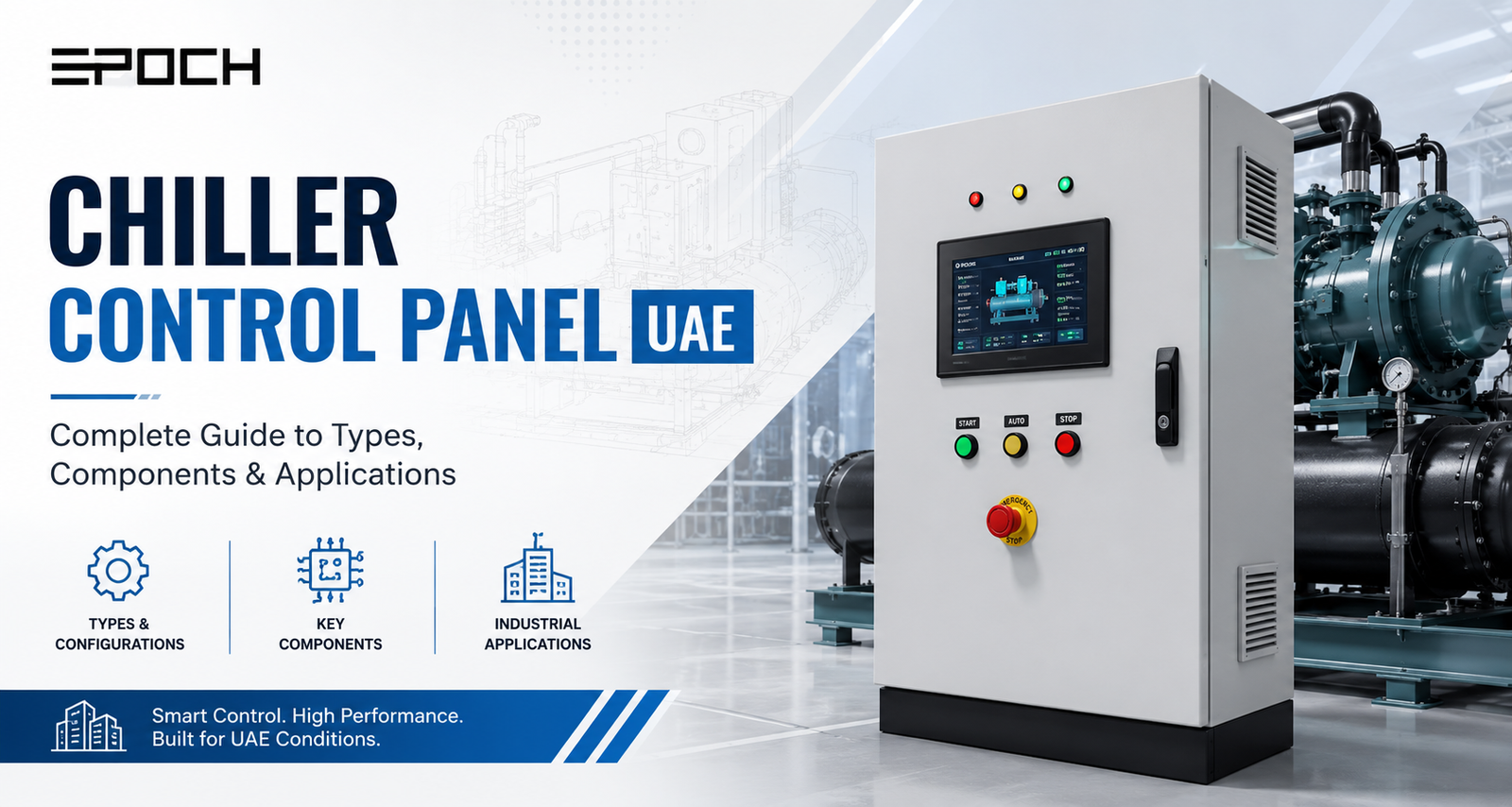
A chiller control panel is the part of the system that makes the decisions. It doesn't cool anything by itself — the compressor, condenser, and evaporator do that work — but it decides when those parts switch on, how hard they run, and when to stop them to avoid damage.
Inside the panel, a controller reads readings from temperature and pressure sensors, compares them to the target settings, and sends signals to switches and drives to keep things in range. It also watches for problems — high pressure, low refrigerant, an overloaded motor — and can shut the chiller down before a small problem turns into a breakdown.
A simple way to think about it: the chiller is the engine, and the control panel is the dashboard and computer that tells the engine when to work and when to stop.
A lot of people searching for “chiller panel” in the UAE end up confused, because the term gets used for two completely different products.
Both matter if you're running a cold storage or chiller system, but they have nothing to do with each other. If you need to insulate a cold room, you want insulated panels. If you need to control or protect a chiller, you need a control panel — which is what this guide is about.
Not every chiller needs the same level of control. The right type depends on the size of the chiller, how many units there are, and whether the site needs to connect to a BMS.
The simplest and oldest type, built from basic switches and timers with simple on/off control. Found on older or smaller chillers. They don't give much detail when something goes wrong, and they're hard to connect to a modern BMS.
The standard setup on most modern chillers. A digital controller handles temperature, pressure, and safety, with a touchscreen showing live readings, settings, and alarm history. Much easier to check and fix than a relay-based panel.
A PLC (programmable logic controller) is a small industrial computer, and panels built around one are used when the chiller is part of a bigger automated system — multiple chillers working together, or other plant equipment that needs to talk to the chiller. A PLC gives far more control flexibility than a fixed digital controller, and can connect to a BMS using standard communication formats.
Built specifically to send information to a building management system — temperature, run hours, faults, energy use — so facilities teams can see everything from one screen instead of walking to each plant room. Common in commercial towers, malls, and hotels.
For sites running two or more chillers — common in large commercial buildings and district cooling — these panels turn chillers on and off based on actual demand, instead of running every unit at all times regardless of need. This is one of the most direct ways to cut energy costs on a site with several chillers.
Whatever the type, most chiller control panels are built from the same basic parts:
Across every panel type, a chiller control panel is doing six jobs:
Saving energy — using speed control and demand-based sequencing to avoid running equipment harder than it needs to.
Lower energy bills. Running compressors and pumps at the speed actually needed, instead of always at full speed, cuts energy use — and cooling is one of the biggest costs on a UAE utility bill.
Fewer breakdowns. Safety cutoffs catch problems like high pressure or an overloaded motor before they turn into a failed compressor, which costs far more to fix than a simple shutdown.
Longer equipment life. Keeping the compressor running within safe limits, instead of letting it strain or cycle on and off from faults, means less wear over the years.
One place to check everything. A BMS-connected panel lets a facilities team see every chiller from one screen, instead of checking each plant room separately — useful on any site with more than one chiller.
Easier reporting. Logged run hours, faults, and energy data make maintenance planning simpler, and increasingly help with green building reporting on newer UAE buildings.
Faster repairs. Fault codes and saved alarm history mean a technician can often spot the issue before even opening the panel, which saves time on both routine visits and emergency callouts.
Chiller control panels show up anywhere there's serious cooling demand, and a few sectors stand out in the UAE:
Commercial towers and office buildings - central chillers connected to a BMS, used to manage energy use across many floors and cut run hours outside office hours.
Shopping malls and retail - cooling demand changes a lot through the day with foot traffic, so panels that adjust output to actual demand stop the building from overcooling during quiet periods.
Hotels - guest comfort matters alongside saving energy across many rooms and zones, usually combining central control with area-by-area monitoring.
Data centers - chillers here run under strict cooling requirements with backup built into the panel design, since any downtime is costly.
District cooling plants - running several large chillers together and deciding which ones to switch on based on demand is central to how district cooling networks manage costs.
Food and beverage, pharma, and industrial sites - chillers used for product cooling (rather than building comfort) often need tighter, PLC-based control to hold a narrow temperature range.
Heat above 45°C, dust, and humidity all put more strain on a chiller control panel here than in milder climates. Enclosures usually need a higher dust and moisture rating — commonly IP54 or above under the IEC ingress protection standard — to keep the electronics inside protected, and components need to handle ambient heat without failing or tripping for no real reason.
Cooling is also one of the largest shares of total building energy use in the UAE, which is why speed control and demand-based switching show up as a real cost saving rather than just a nice-to-have. And with green building requirements becoming more common on new developments, panels increasingly need to be ready to connect to a BMS from day one, instead of being upgraded later.
Epoch International designs, builds, and supports chiller control panels for commercial, industrial, and infrastructure projects across the UAE — from new plant rooms to upgrades on chillers that were never built to connect to a BMS.
New panels - built around the chiller and pump selection from the start, including the logic for running multiple chillers together and making sure the panel is ready to connect to a BMS from day one.
Panel upgrades - replacing worn-out switches and outdated controllers, or adding speed control to compressors and pumps that have run at one fixed speed for years. This is one of the most common requests we get on ageing control systems, and we work around live buildings wherever possible to keep disruption low.
BMS connection upgrades - bringing older chiller plant into an existing or new BMS, including older systems that were never designed to be monitored centrally.
Multi-chiller panels - built around the site's actual demand pattern, not a generic setup copied from another project.
As an ISO 9001-certified industrial automation supplier with supply relationships across ABB, Siemens, Mitsubishi Electric, Schneider Electric, Fuji Electric, Yaskawa, Omron, and Pepperl+Fuchs, we build panels around components already proven on site — not a fixed, off-the-shelf product. If your project also needs PLC repair or reprogramming on existing plant equipment, that's something we support alongside panel work.
Since chiller control panels need to match the specific site, the provider matters as much as the parts they use:
What are the main parts of a chiller control panel?
The controller, the switches (contactors and relays) that turn equipment on and off, the sensors that measure temperature and pressure, and the screen used to set and check everything. Safety cutoffs and wiring connections support all of these.
What is the difference between a chiller control panel and a chiller room panel?
A chiller control panel is the electrical box that runs and protects the chiller. A chiller room panel is the insulated panel used to build a cold room's walls and ceiling. They sound similar but are completely different products.
Do all chillers need a PLC-based control panel?
No. Smaller or simpler chillers usually work fine with a standard digital touchscreen controller. PLC-based panels are mainly needed when the chiller is part of a bigger automated system or needs custom control logic.
Can an old chiller control panel be connected to a BMS later?
Yes. This is one of the most common upgrade requests in the UAE, since many buildings were built before central BMS platforms were standard. Usually it's the panel's communication parts that need upgrading, not the chiller itself.
Why do UAE chiller control panels need a higher protection rating?
Constant heat, dust, and humidity put more strain on electronics here than in milder climates. A higher dust and moisture rating (commonly IP54 or above) helps keep the panel's components protected and prevents random shutdowns caused by heat.
If you're planning a new chiller plant room, upgrading an old control panel, or trying to connect an existing chiller to a BMS it was never built for, send us your equipment list or drawings and your BMS platform, and we'll come back with how we'd approach the panel design and a realistic timeline.
Contact Epoch International to discuss your project.
Didn't Find What You Were Looking For?
Let Us Help You


