




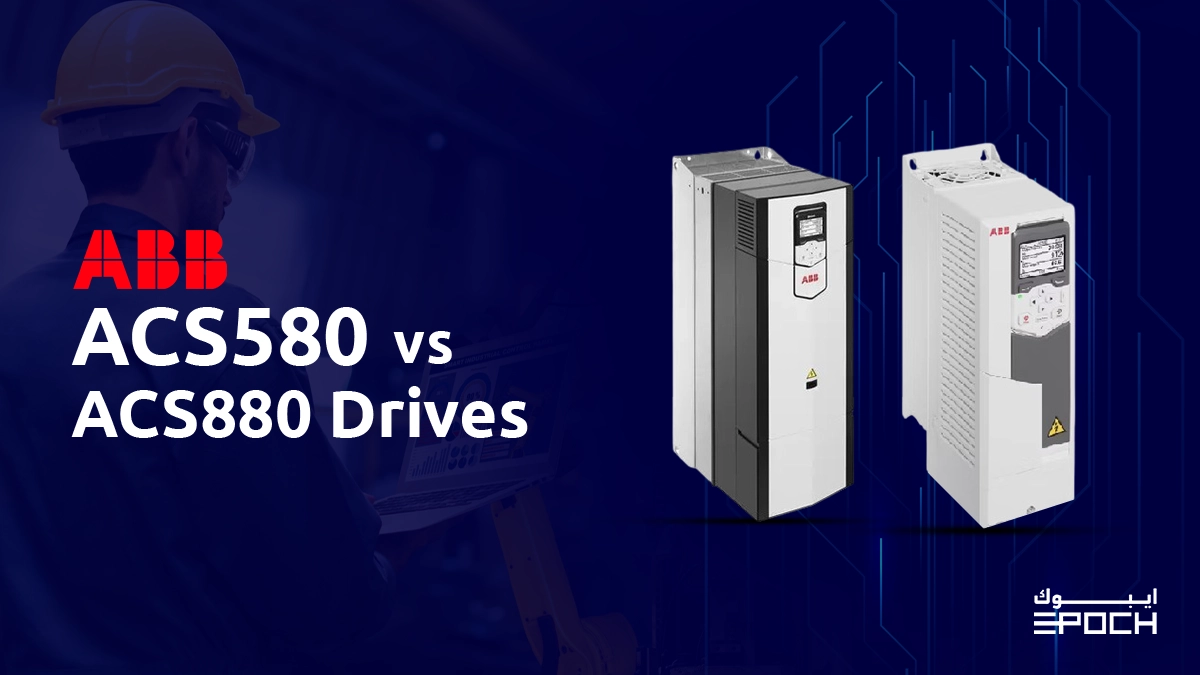
Choosing the Right Drive for Control, Torque and Energy Performance.
ABB ACS580 vs ACS880 is a common comparison when selecting an ABB VFD (Variable Frequency Drive) for industrial applications. While both are proven ABB solutions, they are designed for different performance requirements and operating conditions.
In real industrial environments, VFD selection goes beyond voltage and current ratings. Engineers focus on torque stability, braking performance, system flexibility, and long-term reliability. Understanding where ACS580 and ACS880 fit helps plant teams make smarter, future-ready decisions.
ACS580 vs ACS880 — What is the Real Difference?
The ACS580 is a dependable general-purpose drive built for simplicity, energy efficiency, and fast commissioning. It is designed to handle most common industrial motor control applications without unnecessary complexity.
The ACS880, in contrast, is a high-performance industrial drive intended for demanding applications that require advanced control algorithms, fast torque response, and scalable system architecture.
Control Algorithms: Vector Control vs Direct Torque Control (DTC)
ACS580 — Stable and Practical Control
ACS580 uses sensorless vector control combined with integrated PID functionality. This control approach adjusts motor voltage and frequency smoothly to maintain stable speed and torque under normal load variations. It performs particularly well in pumps, fans, compressors, and conveyors where reliability, ease of setup, and predictable performance are key priorities.
ACS880 — Direct Torque Control (DTC)
ACS880 is equipped with ABB Direct Torque Control (DTC), which directly controls motor torque and flux in real time. Unlike traditional vector control, DTC eliminates the need for a modulator, resulting in much faster torque response. This provides high torque accuracy even at low speeds, faster response to sudden load changes, and reduced mechanical stress on motors and gearboxes. These advantages make ACS880 ideal for cranes, winches, extruders, crushers, and other high-dynamic applications.
Energy Efficiency and Regenerative Braking
ACS580 includes built-in energy optimization features that reduce losses during partial-load operation. ACS880 offers regenerative braking options that feed excess braking energy back into the power grid, significantly improving energy efficiency and lowering operating costs in high-inertia and frequently braking systems.
Application Guide
- Pumps, Fans, Compressors — Best Fit: ACS580. Simple setup, built-in control logic, excellent energy efficiency.
- Conveyors, Mixers (Standard Duty) — Best Fit: ACS580. Reliable vector control, easy commissioning.
- Cranes, Winches, Extruders — Best Fit: ACS880. DTC for high torque accuracy and rapid dynamics.
- High Inertia and Multi-Motor Systems — Best Fit: ACS880. Regenerative braking and configurable multi-drive networks.
- Energy-Sensitive Processes — Best Fit: ACS880 Regenerative. Minimized energy waste, feedback to grid.
Conclusion
Both ABB ACS580 and ACS880 drives are reliable, industrial-grade solutions. The ACS580 is ideal for general-purpose applications where simplicity, efficiency, and fast deployment are essential. The ACS880 excels in advanced applications that demand precise torque control, regenerative energy handling, and high dynamic performance. At Epoch International, a leading industrial automation equipment supplier, we support industries in choosing the right ABB drive solutions based on real-world operating conditions.