



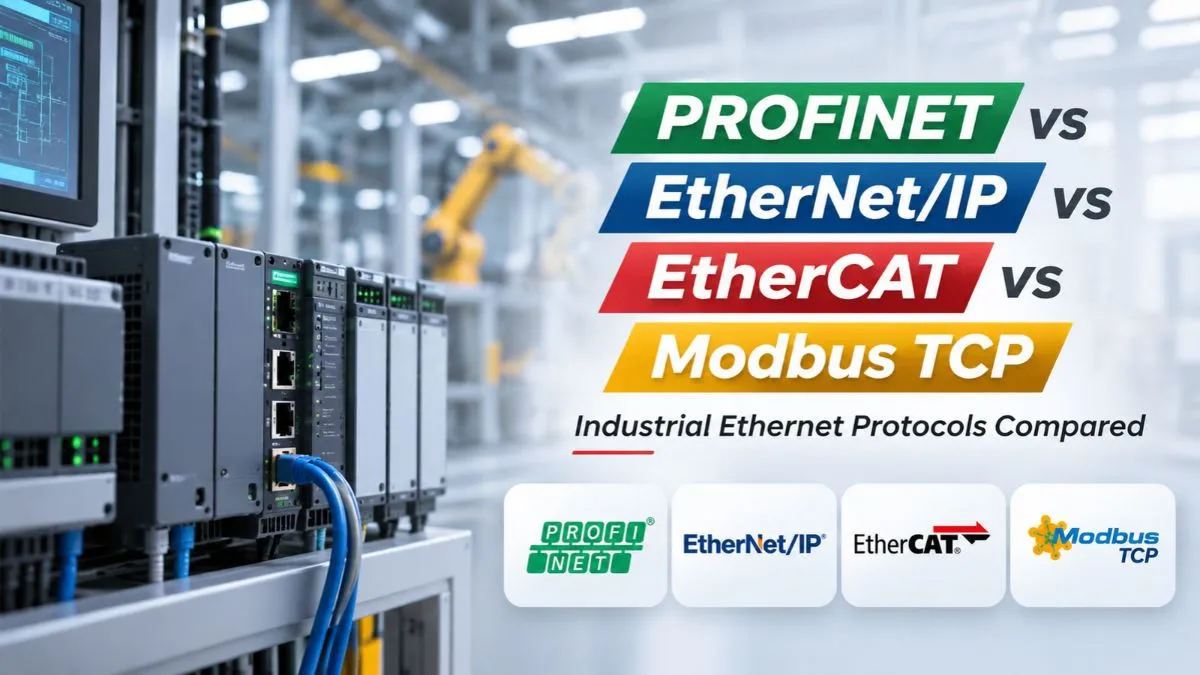
Use PROFINET with Siemens control systems and EtherNet/IP with Allen-Bradley and Rockwell Automation. Pick EtherCAT for fast, tightly synchronized multi-axis motion, and Modbus TCP for simple monitoring, energy meters and SCADA. In most projects the PLC platform makes the decision, and performance needs settle the rest.
Most new automation projects connect their PLCs, drives, remote I/O, HMIs and SCADA over industrial Ethernet, and four protocols cover the majority of them: PROFINET, EtherNet/IP, EtherCAT and Modbus TCP. They all run on Ethernet cable, yet they move data in quite different ways.
This industrial Ethernet protocols comparison looks at how each one works, how they compare on speed, synchronization and complexity, and which one fits factory automation, motion control or monitoring.
What Are Industrial Ethernet Protocols?
An industrial Ethernet protocol is a set of rules that lets automation devices exchange data over Ethernet on a predictable schedule, with the diagnostics a plant needs. Office networks deliver data whenever they can; a production line needs I/O values to arrive at the same interval, every cycle.
These protocols link PLCs and industrial PCs with HMIs, SCADA systems, remote I/O, variable frequency drives (VFDs), servo drives, sensors, actuators and gateways.
They carry two kinds of traffic. Cyclic data, such as I/O values, moves at a fixed interval. Acyclic data, such as configuration, parameters and diagnostics, moves only when something asks for it.
The biggest technical difference between the four is where the cyclic data travels. PROFINET RT/IRT and EtherCAT put it straight into Ethernet frames and skip TCP/IP. EtherNet/IP sends it over UDP/IP, and Modbus TCP over TCP/IP. Most of the differences in speed and determinism follow from that.
If you're also deciding how control and supervision fit together, our guide to SCADA vs PLC vs DCS covers that side.

PROFIBUS & PROFINET International (PI). Controllers (IO-Controllers) exchange data with field devices (IO-Devices) such as distributed I/O, drives and sensors.
It uses three channels on the same cable. PROFINET RT (Real-Time) carries cyclic I/O for standard factory automation directly in Ethernet frames. PROFINET IRT (Isochronous Real-Time) adds scheduled time slots for motion control. Standard TCP/IP or UDP/IP handles configuration, diagnostics and other data that isn't time-critical.
According to PI North America, IRT's default minimum update rate is 250 µs and can drop to 31.25 µs with suitable hardware, with jitter below 1 µs.
PROFINET is the native network for Siemens automation and is common in both manufacturing and process plants. See our range of Siemens PROFINET devices.
EtherNet/IP
EtherNet/IP applies the Common Industrial Protocol (CIP) to standard Ethernet, and ODVA manages it. The IP stands for Industrial Protocol.
Cyclic I/O travels as implicit messages over UDP. Configuration, diagnostics and parameter access travel as explicit messages over TCP. A producer-consumer model lets several devices receive the same data at once, CIP Sync and CIP Motion extend the protocol to synchronized motion, and Device Level Ring (DLR) adds ring redundancy.
EtherNet/IP is the native network for Allen-Bradley and Rockwell Automation systems. See our Allen-Bradley EtherNet/IP controllers.
EtherCAT
Beckhoff Automation developed EtherCAT (Ethernet for Control Automation Technology). The EtherCAT Technology Group (ETG) supports it, and it is standardized in IEC 61158. It uses standard Ethernet frames (EtherType 0x88A4), and each device reads and writes its own data while the frame is still passing through.
The ETG's technical introduction quotes 1,000 distributed digital I/O updated in 30 µs and 100 servo axes in 100 µs, with Distributed Clocks keeping devices synchronized to well below 1 µs. These are manufacturer figures measured under defined conditions.
EtherCAT runs in line, tree, star or ring (cable redundancy) layouts without special switches. You'll find it in robots, CNC machines, semiconductor equipment and fast packaging machines.
To see where it fits on a production line, read our packaging line automation guide.
Modbus TCP
Modbus TCP is the Ethernet version of the Modbus application protocol. A client asks for data and a server answers from its registers and coils, over TCP port 502.
Its strength is how simple and widespread it is. Almost every manufacturer supports it, it connects easily to PLCs and SCADA, and gateways to Modbus RTU are cheap and common. It's the usual choice for energy monitoring, utilities, building automation, instrumentation and older equipment.
See our Schneider Electric Modbus TCP devices.
Industrial Ethernet Protocols Comparison
Table 1: Technical comparison of industrial Ethernet protocols
| Parameter | PROFINET | EtherNet/IP | EtherCAT | Modbus TCP |
|---|---|---|---|---|
| Organization | PI | ODVA | ETG | Modbus Organization |
| Communication model | IO-Controller / IO-Device | Producer-consumer (CIP) | MainDevice / SubDevice | Client-server |
| Cyclic data transport | Ethernet layer (RT/IRT) | UDP/IP | Ethernet layer, processed on the fly | TCP/IP |
| Real-time capability | RT; IRT for motion | Cyclic I/O; CIP Motion | High-performance, deterministic | Request-response, not deterministic |
| Synchronization | IRT | CIP Sync | Distributed Clocks | No native high-precision sync |
| Typical applications | Factory and process automation | Machine and factory automation | Motion control, robotics, CNC | Monitoring, SCADA, energy data |
| Topology | Line, star, ring | Star, line, ring (DLR) | Line, tree, star, ring | Star (standard Ethernet) |
| Safety protocol | PROFIsafe | CIP Safety | FSoE | None standardized |
| Complexity | Moderate | Moderate | Application-dependent | Low |
Real performance depends on the devices, the controller, the topology and how the network is configured.

Does the PLC support the protocol natively?
- Do the drives, sensors, remote I/O and gateways support it?
- What cycle time, response time, data volume and synchronization accuracy does the process need?
- What topology, cable distances, switches and redundancy will the network use?
- Which safety protocol do your safety devices support?
- How will you monitor the network, and how might it grow?
Beyond Ethernet: Fieldbus and Serial Protocols
Industrial communication protocols also include older fieldbus and serial networks that are still running in many plants: PROFIBUS, Modbus RTU (RS-485), CANopen and DeviceNet, plus IO-Link for point-to-point sensor connections. Gateways and couplers link these networks to the industrial Ethernet protocols above, which is often the practical way to modernize a plant one section at a time.
Industrial Ethernet Switches, Gateways and Devices
A reliable network depends on its hardware as much as its protocol. Managed switches add VLANs, traffic prioritization, diagnostics and redundancy; unmanaged switches are fine for small, simple networks. Gateways let devices on different protocols exchange data, and serial-to-Ethernet converters, fiber-optic media converters and wireless devices fill the remaining gaps.
Browse Epoch International's industrial network and communication devices, or the Siemens industrial networking, Moxa networking devices and Schneider Electric networking ranges.
Conclusion
PROFINET and EtherNet/IP are the standard choices for Siemens and Allen-Bradley factory automation. EtherCAT leads in fast, synchronized motion, and Modbus TCP remains the simplest way to connect monitoring and SCADA equipment.
The right choice comes down to your controller, your devices, the performance and safety you need, and how the network will grow.
Epoch International supplies industrial networking equipment, communication modules and automation components from established manufacturers for whichever protocol your plant runs.
Need Industrial Ethernet Networking Equipment?
Planning a new automation network or upgrading an old one? Contact our team for PROFINET and EtherNet/IP switches, gateways and communication modules. We help with product identification, sourcing, availability checks and quotations.
Frequently Asked Questions
What is the difference between PROFINET and EtherNet/IP?
PROFINET RT and IRT send cyclic I/O data directly in Ethernet frames. EtherNet/IP sends it over UDP/IP using the Common Industrial Protocol (CIP). In practice the PLC platform usually decides: PROFINET for Siemens, EtherNet/IP for Allen-Bradley and Rockwell Automation.
Is EtherCAT faster than PROFINET?
Usually, yes, for tightly synchronized multi-axis motion. Each EtherCAT device handles its data as the frame passes, and the EtherCAT Technology Group quotes 100 servo axes updated in 100 µs. PROFINET IRT is close behind: PI North America gives a default update rate of 250 µs, down to 31.25 µs with suitable hardware. Your devices and network design decide the real numbers.
Which industrial Ethernet protocol is the fastest?
EtherCAT is generally the fastest of the four for cyclic I/O and motion, with PROFINET IRT close behind. EtherNet/IP and PROFINET RT cover normal factory automation cycle times. Modbus TCP is the slowest, because every exchange is a request followed by a response over TCP.
What does IP stand for in EtherNet/IP?
Industrial Protocol. EtherNet/IP is the Common Industrial Protocol (CIP) carried over standard Ethernet, and ODVA manages it. It has nothing to do with the IP in TCP/IP, although it does use TCP/IP underneath.
Is Modbus TCP deterministic?
No. Modbus TCP is request-response over TCP, so response times change with network load and polling rate. That's fine for monitoring, energy meters and SCADA, and unsuitable for synchronized motion.
What is the main advantage of Modbus TCP?
Simplicity. A client reads and writes registers on a server over TCP port 502, and almost every manufacturer supports it, which makes it the easiest way to connect devices from different brands.
Can PROFINET and EtherNet/IP work on the same Ethernet network?
They can share the same well-designed Ethernet infrastructure, but they can't exchange data with each other. To connect devices on the two protocols you need a protocol gateway or a controller with both interfaces.
Can EtherCAT and PROFINET be connected?
Yes, with a gateway or coupler that has both an EtherCAT and a PROFINET interface. The gateway copies process data between the two networks. It adds some delay, so keep time-critical motion on a single network.
Which industrial Ethernet protocol is best for PLC communication?
Start with the PLC manufacturer. PROFINET suits Siemens PLCs, EtherNet/IP suits Allen-Bradley controllers, and Modbus TCP is the simple option for connecting devices from different manufacturers.
Do industrial Ethernet networks require special switches?
Industrial-grade switches are recommended wherever there's heat, dust, vibration or electrical noise. You need managed switches for VLANs, redundancy, traffic prioritization or diagnostics, and PROFINET IRT needs switches that support IRT.