




Industrial electrical panels are the backbone of manufacturing plants, process industries, commercial facilities, and automation systems. They distribute power to critical equipment such as motors, PLCs, Variable Frequency Drives (VFDs), Human Machine Interfaces (HMIs), and control circuits. At the heart of every panel is the circuit breaker—a device designed to protect electrical systems from overloads, short circuits, and other faults.
Choosing the right circuit breaker is essential for ensuring equipment safety, minimizing downtime, and maintaining reliable operations. Selecting a breaker based only on its current rating can lead to nuisance tripping, equipment damage, or even serious electrical hazards. This guide outlines the key factors engineers, panel builders, and procurement professionals should consider when selecting circuit breakers for industrial panels.
Why Circuit Breaker Selection Matters
Circuit breakers automatically disconnect electrical circuits when abnormal conditions occur. In industrial environments, electrical systems experience challenges such as motor inrush currents, overloads, short circuits, voltage fluctuations, and harsh operating conditions.
A properly selected circuit breaker protects:
- Motors and motor control centers
- PLCs and automation systems
- VFDs and servo drives
- Power supplies and control circuits
- Industrial machinery
- Personnel working on electrical equipment
Reliable circuit protection reduces maintenance costs, prevents equipment failures, and helps maintain uninterrupted production.
Types of Circuit Breakers
Different industrial applications require different types of circuit breakers.
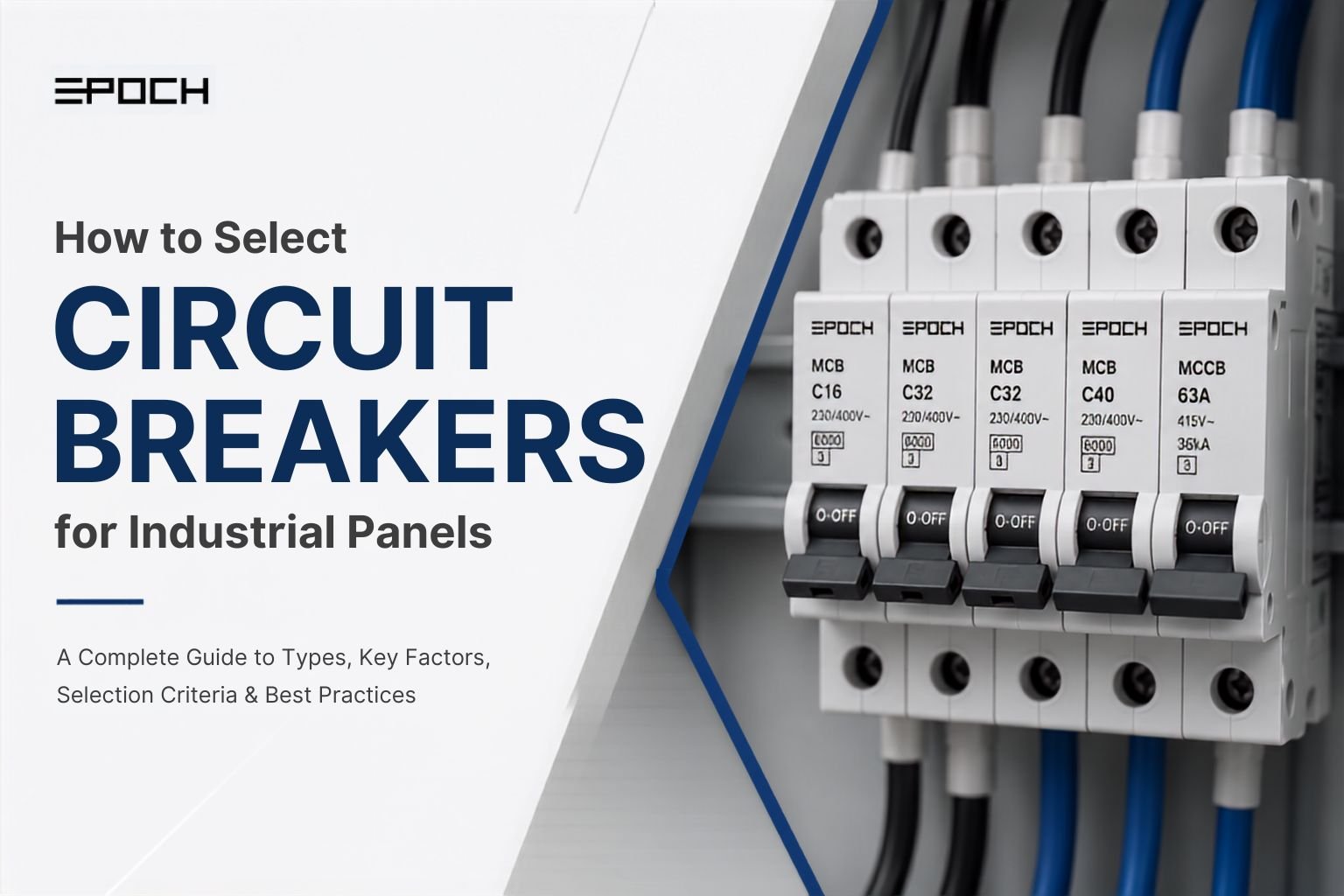
- Miniature Circuit Breakers (MCBs) are commonly used for control panels, lighting circuits, and low-current applications.
- Molded Case Circuit Breakers (MCCBs) are designed for industrial machinery, feeders, and distribution panels where higher current ratings and adjustable protection settings are required.
- Air Circuit Breakers (ACBs) are typically installed as the main incoming protection in large industrial facilities and power distribution systems.
- Motor Protection Circuit Breakers (MPCBs) provide dedicated protection for elec-tric motors against overloads and short circuits.
Selecting the correct breaker type ensures the electrical system receives the appropriate level of protection for its application.
Key Factors to Consider
Load Current
Start by calculating the total load current of the circuit. Consider continuous operating current, starting current, and any future expansion of the system. The breaker should safely handle normal operating conditions without unnecessary tripping while still providing adequate fault protection.
Breaking Capacity
Breaking capacity indicates the maximum fault current the breaker can safely interrupt. In-dustrial systems often require higher breaking capacities than commercial or residential in-stallations. The selected breaker’s interrupting capacity should always exceed the maximum prospective short-circuit current at the installation point.
Trip Characteristics
Trip curves determine how quickly a breaker responds to overcurrent.
- Type B breakers are suitable for lighting and resistive loads.
- Type C breakers are commonly used for industrial control panels and general machinery.
- Type D breakers are recommended for equipment with high inrush currents, such as motors, transformers, and compressors.
Choosing the correct trip curve helps prevent nuisance tripping while maintaining effective protection.
Environmental Conditions
Industrial environments vary widely, and surrounding conditions can influence breaker perfor-mance.
Factors to evaluate include:
- Ambient temperature
- Dust and moisture
- Corrosive chemicals
- Mechanical vibration
- Installation altitude
Facilities such as chemical plants, marine installations, mining operations, and food process-ing plants may require circuit breakers designed for harsh environments.
MCB vs MCCB: Which One Should You Choose?
Although MCBs and MCCBs serve similar purposes, they are designed for different applications.
| Feature | MCB | MCCB |
| Current Rating | Low | Medium to High |
| Adjustable Trip Settings | No | Yes (on many models) |
| Typical Application | Control circuits | Industrial machinery |
| Breaking Capacity | Moderate | High |
MCBs are ideal for smaller circuits and control panels, while MCCBs provide greater flexi-bility and protection for larger industrial loads.
Common Mistakes to Avoid
Many electrical failures result from improper circuit breaker selection rather than product de-fects.
Common mistakes include:
- Choosing a breaker based only on current rating
- Ignoring motor starting current
- Selecting inadequate breaking capacity
- Using the wrong trip curve
- Poor coordination with other protection devices
- Not considering future load expansion
Careful planning during panel design helps prevent expensive downtime and maintenance issues.
Applications Across Industries
Circuit breakers are essential in a wide range of industries, including:
- Manufacturing
- Oil and Gas
- Food and Beverage
- Pharmaceutical
- Water and Wastewater Treatment
- Renewable Energy
- Marine
- Mining
- Packaging
- Building Automation
Each application presents unique electrical demands, making proper circuit breaker selection a key aspect of system reliability and safety.
Popular Circuit Breaker Brands and Series
Some of the most trusted circuit breaker manufacturers and their popular product series include:
- Schneider Electric: Acti9 iC60, Easy9, ComPacT NSX, MasterPact MTZ
- Siemens: 5SY, 5SL, 3VA, 3WL
- ABB: S200, Tmax XT, Emax 2, MS Series
- Eaton: FAZ, NZM, IZMX, PKZM0
- Mitsubishi Electric: NF, NV, CP30 Series
- Fuji Electric: BW Series, G-TWIN Series
- Rockwell Automation (Allen-Bradley): 140M, 140U, 1492 Series
Selecting genuine products from these globally recognized brands helps ensure reliable circuit protection, compliance with international standards, improved operational safety, and long-term performance in industrial electrical panels.
Circuit Breaker Selection Checklist
Before purchasing or installing a circuit breaker, verify the following:
- Correct breaker type (MCB, MCCB, ACB, or MPCB)
- Appropriate current rating
- Adequate breaking capacity
- Suitable trip curve
- Compatibility with the application
- Compliance with relevant standards
- Proper coordination with other protection devices
- Allowance for future expansion
Following this checklist helps improve system safety and operational reliability.
Frequently Asked Questions
What happens if a circuit breaker is undersized for the application?
An undersized breaker will trip frequently under normal operating and starting currents, causing nuisance shutdowns and unplanned downtime. In some cases it can also fail to provide adequate protection during genuine fault conditions if the trip curve doesn't match the load type.
Can I use an MCB instead of an MCCB for industrial machinery?
Generally no. MCBs are built for lower current ratings and fixed trip settings, which limits their suitability for industrial machinery with higher inrush currents. MCCBs offer higher breaking capacity and adjustable trip settings better suited to industrial loads.
How does high ambient temperature affect circuit breaker performance?
Breaker ratings are based on a reference ambient temperature, commonly 40°C. Operating above that threshold reduces the breaker's effective current-carrying capacity, so a breaker sized correctly at standard conditions may trip prematurely or overheat in a hot plant room or outdoor enclosure without proper derating.
How often should industrial circuit breakers be inspected or replaced?
Most manufacturers recommend periodic inspection as part of routine maintenance, typically annually for critical panels, with closer intervals in harsh environments. Breakers should also be reassessed whenever loads are added or the panel is reconfigured.
How Epoch International Can Help
Selecting the right circuit breaker is only one part of building a dependable electrical system. Sourcing genuine components from a trusted supplier is equally important.
Epoch International supplies a comprehensive range of industrial electrical and automation products from globally recognized manufacturers. Our product portfolio includes circuit break-ers, PLCs, HMIs, VFDs, relays, sensors, power supplies, industrial communication devices, and other automation components for new projects, maintenance, and replacement requirements.
With an extensive global sourcing network, we assist customers in locating standard, hard-to-find, and obsolete industrial components while ensuring quality, competitive pricing, and timely delivery. Our experienced procurement team works closely with customers to identify the right products for their applications and support reliable industrial operations.
Conclusion
Selecting the right circuit breaker involves much more than matching the current rating. En-gineers and procurement professionals must evaluate load characteristics, breaking capacity, trip curves, environmental conditions, and application requirements to ensure safe and reliable operation.
By choosing the appropriate circuit breaker and sourcing genuine products from trusted suppliers, organizations can reduce downtime, improve equipment protection, and enhance the long-term reliability of their industrial electrical systems.
Whether you are designing a new control panel or upgrading an existing installation, careful circuit breaker selection is an investment in safety, efficiency, and operational continuity.