




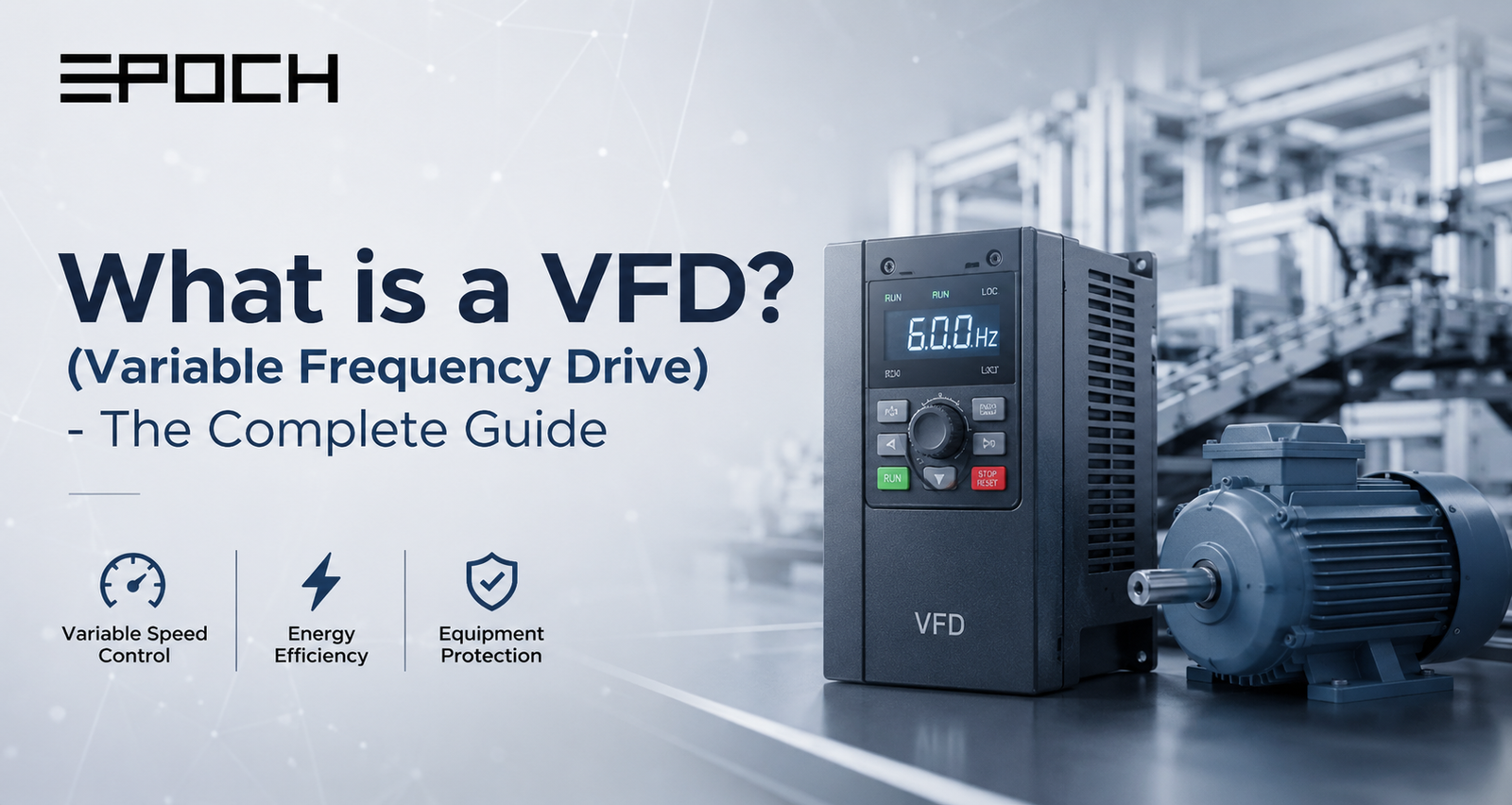
A Variable Frequency Drive (VFD) is an electronic device that controls the speed and torque of an AC electric motor by varying the frequency and voltage of the electrical power supplied to it. Instead of a motor running at one fixed speed determined by the power grid (50 Hz or 60 Hz), a VFD lets you run that same motor anywhere from a crawl to above its rated speed, on demand, in real time.
Think of it like this: a wall socket gives a motor exactly one "gear" — full speed, all the time, the moment you switch it on. A VFD turns that one-speed motor into something closer to a car with a continuously variable transmission. You decide how fast it actually needs to go, and the VFD makes that happen electrically, with no gears, belts, or mechanical throttling involved.
VFDs are also called adjustable speed drives (ASD), variable speed drives (VSD), adjustable frequency drives (AFD), AC drives, frequency converters, or simply inverters — all of these terms refer to the same family of device, with minor regional or industry preferences in naming (more on that below).
In one sentence: A VFD takes fixed-frequency AC power in, converts it to DC, then synthesizes new AC power at a frequency and voltage you choose, and sends that to the motor — and because motor speed is directly tied to supply frequency, controlling frequency means controlling speed.
| 💡 Key Insight |
|---|
| More than 50% of the world's electrical energy is consumed by electric motors. Most of these motors still run at full speed regardless of actual demand; a VFD fixes that inefficiency directly. |
Why VFDs Exist: The Problem They Solve
Before VFDs existed (and even today, in systems that don't use them), engineers faced a hard problem: standard AC induction motors run at essentially one speed, set by the frequency of the power grid and the number of poles wound into the motor. There's no dial on the motor itself.
So how did older systems control flow, pressure, or speed? Mechanically and wastefully:
- Throttling valves and dampers — run the pump or fan at full speed always, then physically restrict the output to get the flow you actually need. You're paying for 100% of the energy to get 60% of the result.
- On/off cycling — turn the motor fully on, then fully off, repeatedly, to approximate an average output. Hard on motors, gears, and starting components.
- Mechanical gearboxes or pulley changes — physically swap components to get a different fixed speed. Not adjustable in real time.
- Multiple fixed-speed motors — install a small motor and a large motor and switch between them. Expensive, bulky, inflexible.
Every one of these wastes energy, adds mechanical wear, or both. A VFD solves the root problem directly: instead of generating 100% output and wasting the difference, it generates exactly the output the process needs, electrically, with no physical throttling at all.
This is also why energy savings is the single most-cited benefit of VFDs; it isn't marketing fluff, it's a direct consequence of replacing wasteful mechanical regulation with precise electrical regulation.
Benefits of Using a VFD
Energy Savings (Primary Benefit)
For variable torque loads like fans and pumps, VFDs deliver extraordinary energy savings governed by the Affinity Laws. Reducing fan speed by just 20% cuts power consumption by approximately 49%.
| Speed Reduction | Power Reduction (Affinity Law) | Practical Example — 100 kW Fan |
|---|---|---|
| 10% (run at 90%) | 27.1% power saved | 100 kW → 72.9 kW |
| 20% (run at 80%) | 48.8% power saved | 100 kW → 51.2 kW |
| 25% (run at 75%) | 57.8% power saved | 100 kW → 42.2 kW |
| 50% (run at 50%) | 87.5% power saved | 100 kW → 12.5 kW |
Precise Process Control
Before VFDs, controlling process flow meant running motors at full speed and throttling output with mechanical valves, dampers, or guillotine gates. This is like driving with the accelerator floored and controlling speed using the brakes — wasteful and mechanically stressful.
A VFD eliminates this entirely: conveyors run at exactly the speed the product needs, pumps maintain constant pressure regardless of demand variations, and fans adjust airflow in real-time to conditions.
Extended Equipment Life
Without a VFD, a Direct-On-Line (DOL) motor start draws 500–700% of its rated current — an enormous electrical and mechanical shock to the motor, the driven load, and the entire power system. This happens every single time the motor starts. For a deeper look at how starting methods affect motor and equipment life, see our guide on designing a reliable motor control circuit using contactors and starters.
Other Key Benefits
- Noise & Vibration Reduction: Fans and pumps at lower, optimized speeds are dramatically quieter — critical in hospitals, offices, data centers
- Improved Power Factor: Standard induction motors have power factor of 65–85%; VFDs bring system power factor close to 96%, reducing reactive power utility penalties
- Lower CO2 Emissions: Reduced energy means fewer kg of CO2 per operating hour — critical for sustainability commitments
- Phase Conversion: Some VFDs accept single-phase input and output three-phase power — useful where three-phase supply is unavailable
- Fast ROI: A correctly sized VFD on a fan or pump typically pays for itself within 6–12 months through energy savings alone
How a VFD Works - The 3-Stage Architecture
A standard VFD has three main internal stages. Understanding each stage demystifies exactly how frequency and voltage control is achieved:
Stage 1: Rectifier (Converter): AC → DC
The rectifier is the front-end of the VFD. It takes incoming 3-phase AC power (50 or 60 Hz) and converts it to DC using six diodes, one pair per phase. Each diode opens when its phase voltage is highest, creating six current pulses per cycle.
- This is why standard VFDs are called "6-pulse VFDs" — six current pulses are produced per AC cycle
- The output is a pulsating DC voltage (approximately 650V DC for a 415V AC input)
- Modern premium drives — including ABB, Siemens, and Schneider Electric drives — increasingly use Silicon Carbide (SiC) MOSFETs instead of diodes, enabling regeneration, lower harmonics, and higher efficiency
Stage 2: DC Bus: Smoothing & Energy Storage
The DC bus takes the pulsating DC from the rectifier and smooths it using large electrolytic capacitors (and sometimes a DC link inductor/choke).
- Capacitors act as a reservoir — absorbing ripple and maintaining a stable, smooth DC voltage (~650V for a 415V system)
- DC link chokes on the bus also reduce harmonic distortion feeding back to the power supply
- The capacitors are the component most likely to age over time — typically lasting 10–15 years and are a key item to check during routine VFD repair and maintenance
Stage 3: Inverter: DC → Variable AC via PWM
The inverter converts DC back to AC at whatever frequency the process needs. It uses six IGBTs (Insulated-Gate Bipolar Transistors) — switching on and off at 2–16 kHz carrier frequency.
- By controlling when each IGBT fires using Pulse Width Modulation (PWM), the inverter creates pulses that simulate a sine wave at any desired frequency (0–400+ Hz)
- To change output from 50 Hz to 25 Hz, pulses are spaced further apart
- Voltage is also scaled proportionally to maintain constant V/Hz ratio and preserve motor torque capability
Pulse Width Modulation (PWM) Explained
The inverter does not produce a true sine wave. Instead, it switches high-voltage DC pulses on and off at very high speed to simulate a sine wave — this is called Pulse Width Modulation (PWM).
| 🔬 Why IGBTs Matter |
|---|
| IGBTs (Insulated-Gate Bipolar Transistors) are the switching devices in the inverter. They can switch millions of times per second, handle high voltages efficiently, and are the reason modern VFDs are so compact and reliable. Newer drives use SiC MOSFETs for even faster switching, less heat, and higher efficiency. |
VFD Working Principle
The speed of an AC induction motor is directly tied to the frequency of the AC power supply. This relationship is expressed by the synchronous speed formula:
Synchronous Motor Speed Formula: Ns = (120 × f) ÷ P Ns = Synchronous Speed (RPM) | f = Frequency (Hz) | P = Number of Poles
This formula reveals the secret: change the frequency (f), and you change the motor speed. That is exactly what a VFD does. It takes incoming fixed-frequency AC power (50 Hz in most regions, 60 Hz in North America), converts it to DC internally, and then recreates new AC power at whatever frequency the process demands.
Crucially, the VFD also scales voltage proportionally with frequency to maintain the correct V/Hz ratio. If frequency drops to 50% (25 Hz), voltage is also reduced to 50%. This keeps the motor's magnetic flux constant and prevents overheating or torque loss.
For a real-world look at how this plays out across two drives from the same family, see our comparison of the ABB ACS580 vs ACS880.
VFD Applications - Where Are They Used?
VFDs are used anywhere an AC motor drives a variable load. The applications span virtually every industry:
| Application | Specific Uses | Primary Benefit |
|---|---|---|
| HVAC Fans | AHU, supply/return fans, cooling tower fans, exhaust fans | Energy savings 30–60% |
| Centrifugal Pumps | Water supply, chilled water, booster pumps, irrigation | Constant pressure, 40–60% savings |
| Compressors | Air compressors, refrigeration, gas compression | Part-load efficiency |
| Conveyor Belts | Material handling, food processing, packaging lines | Precise speed, soft start |
| Cranes & Hoists | Overhead cranes, gantry cranes, elevators, lifts — see our crane automation division | Precise positioning, safety |
| Water Treatment | Sewage pumps, aerators, blowers, filter presses | Energy + process control |
| Marine Propulsion | Ship thrusters, propulsion motors, bow thrusters — part of our marine automation division | Speed & fuel efficiency |
| Machine Tools | CNC spindles, lathes, milling, grinding machines | Precision speed control |
| Renewable Energy | Wind turbines, solar pump inverters, tidal systems | Power conversion |
Who Needs a VFD Most?
VFDs deliver the highest ROI for operations with variable load AC motors running more than 2,000 hours per year. Here is who benefits most:
| Industry / Sector | Key Applications | Expected Savings |
|---|---|---|
| Manufacturing Plants | Compressors, conveyors, fans, cooling systems, hydraulic pumps | 20–50% on motor energy |
| Commercial Buildings (HVAC) | Air handling units, fan coil units, cooling towers, chillers | 30–60% on HVAC energy |
| Water Utilities | Water supply stations, sewage treatment, pressure boosting | 25–45% on pump energy |
| HVAC & Cold Storage | Refrigeration compressors, chiller plants, cold stores | 30–50% at part-load |
| Plastics & Extrusion | Extruders, winders, film lines | 15–35% + quality gains |
| Marine & Offshore | Electric propulsion, thrusters, ballast, deck machinery | 25–40% fuel savings |
Types of VFDs
By Control Method
| Control Type | How It Works | Best Application | Complexity |
|---|---|---|---|
| V/Hz (Scalar) | Maintains constant Voltage/Frequency ratio. Open-loop, no encoder. | Fans, pumps, simple conveyors | Low — Most common |
| Sensorless Vector | Estimates rotor position via motor model. Better low-speed torque. | General manufacturing, mixers | Medium |
| Closed-Loop Vector (FOC) | Uses encoder feedback for precise torque and speed control. | Elevators, CNC, winders, hoists | High — Premium |
| Direct Torque Control (DTC) | Controls torque and flux directly. Fastest dynamic response. | Cranes, paper mills, process lines | Very High — Specialist |
By Voltage Level
| Category | Voltage Range | Typical Power Range | Applications |
|---|---|---|---|
| Low Voltage (LV) | Up to 690V AC | 0.2 kW – 2 MW | Most industrial, commercial, HVAC applications |
| Medium Voltage (MV) | 1 kV – 15 kV | 200 kW – 100+ MW | Mining, oil & gas, large water utilities — see our industrial VFD panels |
| High Voltage | Above 15 kV | Multi-MW | Power plants, ship propulsion systems |
By Input Phase
| Type | Input | Output | Typical Use Case |
|---|---|---|---|
| Single-Phase Input VFD | 1-phase 230V | 3-phase to motor | Small pumps, sites without 3-phase supply |
| Three-Phase Input VFD | 3-phase 415V | 3-phase to motor | Industrial, commercial, all standard applications |
How to Choose the Right VFD: 8-Step Selection Guide
Step 1: Identify Motor Nameplate Data Collect: rated kW (or HP), rated voltage (V), rated current (A), rated frequency (Hz), number of poles, rated RPM, insulation class, and motor type (IM, PMSM, SynRM). The motor nameplate has everything you need.
Step 2: Determine Load Type Variable torque loads (fans, pumps, centrifugal compressors) — choose VFD by motor kW rating. Constant torque loads (conveyors, positive displacement pumps, extruders) — size VFD based on motor Full Load Amperes (FLA), often one frame size larger than the motor kW would suggest.
Step 3: Select VFD Output Current ≥ Motor FLA VFD output current rating must be equal to or greater than motor full-load amperes (FLA). For constant-torque loads, add 10–20% margin. Never size purely by kW — ampere rating is the critical specification.
Step 4: Choose Control Method
V/Hz for simple fans and pumps. Sensorless vector for better low-speed torque control. Closed-loop vector (with encoder) for precision positioning and speed holding. Direct torque control (DTC) for demanding dynamic applications like cranes.
Step 5: Check Environment & Enclosure Rating IP20 for clean indoor electrical rooms. IP54/IP55 for dusty or splash environments. IP66 for outdoor or washdown applications. NEMA 4X for corrosive environments. Standard VFDs are rated to 40°C ambient — derating tables apply above that.
Step 6: Plan for Accessories
Input: line reactor or EMC filter for harmonic mitigation. Output: dV/dt filter if cable length exceeds 30m or motor insulation is not inverter-rated. Braking: braking chopper and resistor for high-inertia loads (cranes, hoists). Shaft grounding rings for motors above 15 kW.
Step 7: Consider Communication Protocol Modbus RTU for older SCADA/PLC systems. Profibus, DeviceNet for legacy automation. EtherNet/IP, PROFINET, Modbus TCP for modern networked facilities. BACnet MS/TP or BACnet IP for building management systems (BMS) — very common in commercial HVAC.
Step 8: Calculate Total Cost of Ownership & ROI Add: VFD purchase price + installation + accessories + commissioning + annual maintenance. Factor in energy savings from day one. Use the formula: Annual savings (kWh) = Motor kW × Hours × (1 − Speed Ratio³) × tariff rate. For most fan/pump applications, ROI is 6–18 months.
Getting It Right the First Time
A VFD pays for itself fastest when it's sized and specified correctly from day one — undersizing leads to nuisance trips, oversizing wastes capital, and the wrong control method leaves torque on the table exactly where you need it most. If you're not sure which drive, panel, or accessory combination fits your application, our engineers can review your motor nameplate data and load type and recommend a configuration before you buy.
Browse our VFD range → or talk to our automation team → for a free sizing review.