




Introduction
Industrial automation is evolving rapidly, and choosing the right Programmable Logic Controller (PLC) is one of the most important decisions when designing or upgrading a control system. Whether you're automating a simple packaging machine or managing a complex production line, selecting between a Modular PLC and a Compact PLC can significantly impact system performance, scalability, maintenance, and overall cost.
Epoch International supplies a wide range of industrial PLCs from globally recognized brands to support manufacturing, utilities, oil & gas, food processing, pharmaceuticals, marine, and many other industries. Their PLC solutions are designed to deliver reliable automation for applications of every size.
This guide compares Modular and Compact PLCs, explains their advantages, and helps you determine which solution best fits your automation requirements. If you're also evaluating where a PLC fits among other control architectures, see our comparison of SCADA vs PLC vs DCS systems.
What Is a PLC?
A Programmable Logic Controller (PLC) is an industrial computer specifically designed to monitor inputs, execute programmed logic, and control outputs in real time. PLCs are built to withstand harsh industrial environments including vibration, dust, humidity, and electrical noise.
PLCs are commonly used to automate:
- Manufacturing equipment
- Conveyor systems
- Packaging machines
- Water treatment plants
- HVAC systems
- Process industries
- Material handling systems
- Robotics and motion control
Modern PLCs offer fast processing, reliable operation, and seamless communication with HMIs, SCADA systems, sensors, and industrial networks.
What Is a Compact PLC?
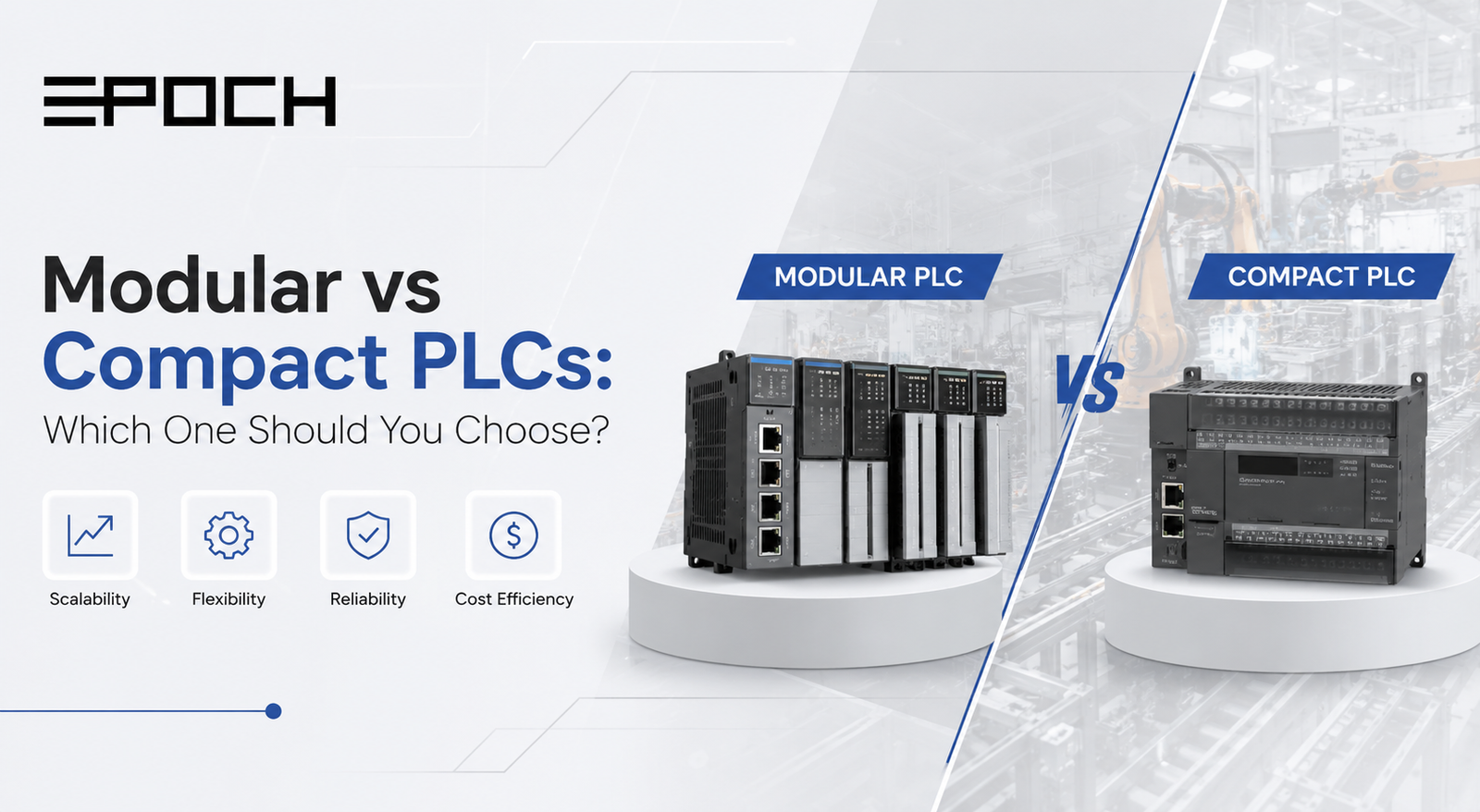
A Compact PLC integrates the CPU, power supply, and input/output (I/O) modules into a single enclosure. Everything required for operation is preassembled, making installation quick and straightforward.
Key Advantages
- Cost-effective solution
- Simple installation
- Small control panel footprint
- Minimal wiring
- Reliable all-in-one design
- Lower maintenance requirements
Best Applications
Compact PLCs are ideal for:
- Packaging machines
- Standalone production equipment
- Small conveyor systems
- Pumping stations
- HVAC control
- Food processing equipment
- Building automation
Practical Example
A packaging machine requiring 40 digital I/O points and basic motor control typically benefits from a compact PLC. Since future expansion is unlikely, an integrated controller minimizes installation cost while providing reliable performance.
What Is a Modular PLC?
A Modular PLC consists of separate hardware modules mounted on a rack or backplane. Modules can be added or replaced individually according to system requirements.
Typical modules include:
- CPU
- Power supply
- Digital inputs
- Digital outputs
- Communication Modules
- Motion Control Modules
- Safety Modules
- Process Control Modules
Key Advantages
- Excellent scalability
- Flexible system configuration
- Higher processing power
- Large I/O capacity
- Easy module replacement
- Advanced industrial networking
- Lower long-term upgrade costs
Best Applications
Modular PLCs are ideal for:
- Oil and Gas
- Chemical Processing
- Pharmaceutical Manufacturing
- Automotive Production
- Steel Plants
- Marine Automation
- Power Generation
- Large Conveyor Systems
- Process Industries
Practical Example
A pharmaceutical production line with multiple conveyors, SCADA integration, servo systems, and future expansion plans requires a modular PLC. Additional I/O and communication modules can easily be added without replacing the entire controller.
Modular PLC vs Compact PLC
| Feature | Compact PLC | Modular PLC |
|---|---|---|
| Design | Integrated all-in-one | Separate modules |
| Initial Cost | Lower | Higher |
| Expansion | Limited | Excellent |
| I/O Capacity | Fixed | Expandable |
| Maintenance | Entire unit replacement | Individual module replacement |
| Installation | Simple | More complex |
| Flexibility | Limited | Very high |
| Panel Space | Smaller | Larger |
| Processing Power | Moderate | High |
| Best For | Small to medium systems | Medium to large industrial systems |
Major PLC Brands and Popular Series
Epoch International supplies PLCs from leading global automation manufacturers, offering both compact and modular solutions for a wide range of industrial applications.
| Brand | Popular Compact Series | Popular Modular Series |
|---|---|---|
| Siemens | SIMATIC S7-200 SMART, S7-1200 | SIMATIC S7-1500, S7-300, S7-400 |
| Schneider Electric | Modicon M221, M241 | Modicon M340, M580 |
| Mitsubishi Electric | MELSEC FX5U, iQ-F | MELSEC iQ-R, Q Series |
| Omron | CP1E, CP1H | NJ Series, NX Series, CJ2 |
| Allen-Bradley | Micro820, Micro850 | CompactLogix, ControlLogix |
| Delta Electronics | DVP Series | AS Series, AH Series |
| LS Electric | XGB Series | XGK, XGI, XGR |
| ABB | AC500-eCo | AC500, AC500-S |
| Panasonic | FP0R, FP-X | FP7 |
| Keyence | KV Nano Series | KV-7000, KV-8000 |
How to Choose the Right PLC
Before selecting a PLC, consider the following:
Choose a Compact PLC if you need:
- A cost-effective automation solution
- Limited I/O requirements
- Small control panels
- Simple machine automation
- Quick installation
Choose a Modular PLC if you require:
- Future expansion
- High-speed processing
- Advanced networking
- Large I/O capacity
- Easy maintenance
- SCADA or Industrial Ethernet integration
If your existing setup is already struggling with outdated I/O capacity or networking limitations, it may also be worth reviewing the common issues with aging industrial control systems before deciding between an upgrade and a like-for-like replacement.
Why Choose Epoch International?
Epoch International supports industries with a comprehensive portfolio of industrial automation products, including PLCs, HMIs, VFDs, industrial networking devices, motion control products, sensors, machine vision systems, and repair services. The company focuses on quality products, technical expertise, and timely delivery to help customers reduce downtime and improve operational efficiency. If a PLC is already in service and showing faults rather than needing replacement, our team also offers dedicated PLC repair and programming services.
Conclusion
Both Compact PLCs and Modular PLCs play essential roles in industrial automation. Compact PLCs are ideal for cost-effective, standalone applications, while Modular PLCs provide the flexibility, processing power, and scalability required for larger and more complex automation systems.
Choosing the right PLC depends on your application's size, communication requirements, future expansion plans, and budget.
Need help selecting the right PLC?
Contact Epoch International for expert guidance and access to genuine PLCs, automation components, and industrial control solutions from the world's leading manufacturers.