




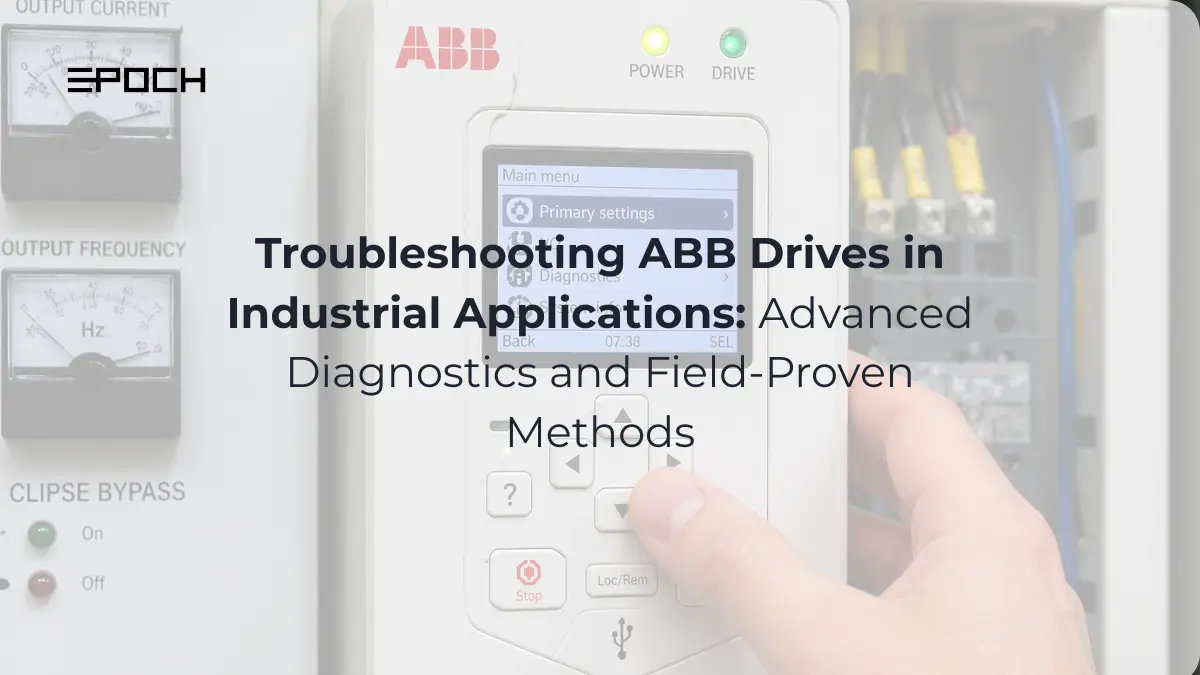
This guide focuses on practical, engineer-level troubleshooting for ABB drives used in real industrial environments, with emphasis on power electronics, signal integrity, and system interaction.
How ABB Drives Work in Real Systems (Beyond Theory)
An ABB drive converts incoming AC supply into DC through a rectifier stage, stabilizes it across a DC link (bus capacitors), and then reconstructs a controlled AC output via an IGBT-based inverter using Pulse Width Modulation (PWM).
Key internal sections:
- Input rectifier (diode/thyristor bridge)
- DC link capacitors (energy storage + ripple smoothing)
- Inverter stage (IGBT modules + gate drivers)
- Control PCB (microcontroller/DSP executing control algorithms)
- Feedback circuits (current sensors, voltage sensing, thermal sensors)
Failures can originate in any stage but usually surface as overcurrent, overvoltage, thermal, or communication faults.
High-Frequency Faults and Their Technical Root Causes
1) Overcurrent Trip (OC)
Symptom: Immediate trip during start or load changes.
Technical causes:
- Stator winding short or phase-to-phase fault
- Ground fault leakage due to insulation breakdown
- Improper V/f curve or torque boost settings
- Aggressive acceleration ramp (dI/dt surge)
What to check:
- Motor insulation resistance (megger test, MΩ range)
- Output phase balance and cable integrity
- Torque limit and current limit parameters
2) DC Bus Overvoltage (OV)
Symptom: Trips during deceleration.
Technical causes:
- Regenerative energy (back EMF) feeding the DC link
- Missing or undersized dynamic braking resistor
- High inertia loads with short decel time
What to check:
- DC bus voltage vs rated threshold
- Deceleration time constant
- Braking chopper operation and resistor sizing
3) Thermal Overload / Heatsink Overtemperature
Symptom: Intermittent trips after prolonged operation.
Technical causes:
- Increased junction temperature (Tj) of IGBTs
- Thermal resistance rise due to dust accumulation
- Cooling fan RPM drop (bearing wear)
- High switching frequency (kHz) increasing switching losses
What to check:
- Fan operation and airflow path
- Heatsink cleanliness
- Ambient temperature inside panel
- Thermal sensor readings (NTC/PTC feedback)
4) Ground Fault (GF)
Symptom: Trip on start or under load.
Technical causes:
- Insulation degradation in motor cables
- Moisture ingress or cable sheath damage
- Improper earthing/grounding impedance
What to check:
- Insulation resistance (phase-to-earth)
- Cable routing and shielding
- Grounding system continuity
5) Communication / Fieldbus Errors
Symptom: Loss of control, intermittent signals.
Protocols involved:
- Modbus RTU / TCP
- Profibus DP
- Ethernet/IP
Technical causes:
- EMI (Electromagnetic Interference)
- Incorrect baud rate, node ID, or termination
- Signal attenuation over long cable runs
What to check:
- Shielded cable usage and grounding at one end
- Termination resistors
- Network diagnostics (packet loss, latency)
Structured Troubleshooting Workflow (Used on Site)
Step 1: Decode Fault Logs and Parameter History
ABB drives store faults in parameter registers. Correlate fault timestamps with process events (startup, load spike, shutdown). Avoid blind resets, use logs to narrow root causes.
Step 2: Power Quality Assessment
Poor supply conditions degrade performance over time.
Measure:
- THD (Total Harmonic Distortion)
- Voltage imbalance (%) across phases
- Frequency stability
- Transient spikes (oscillography)
Insight: Non-linear loads introduce harmonics (5th, 7th, 11th) that increase RMS current and heating in drives.
Step 3: DC Link Evaluation
Check DC bus voltage across capacitors:
- Compare with nominal DC value (≈ 1.35 × line voltage for 3-phase)
- Inspect for ripple voltage (capacitor aging)
- Look for bulging or ESR increase in capacitors
Step 4: Insulation and Leakage Testing
Use a megohmmeter:
- Phase-to-phase and phase-to-earth readings
- Trending over time to detect insulation decay
Step 5: Parameter Validation
Confirm:
- Motor nameplate data (V, A, Hz, RPM)
- Switching frequency (kHz) vs thermal limits
- Acceleration/deceleration ramps
- Current limits, torque limits, and protection settings
Misconfiguration often mimics hardware faults.
Advanced Diagnostic Techniques (For Complex Cases)
Harmonic Spectrum Analysis
Use a power analyzer to identify harmonic orders. Excessive harmonics cause:
- Additional copper and core losses
- Overheating of IGBTs and motors
- Nuisance tripping
Mitigation: Line reactors, passive/active harmonic filters.
Thermographic Inspection
Infrared imaging reveals:
- Hotspots on IGBT modules
- Uneven thermal distribution
- Poor heatsink coupling
Oscilloscope-Based PWM Analysis
Validate:
- PWM waveform integrity
- Switching edge behavior
- Noise coupling into control signals
Signal Integrity Testing
Check fieldbus signal levels and noise margins. Validate shielding, grounding, and cable routing to reduce EMI.
Component-Level Repair Considerations
Repair is viable when damage is localized:
- IGBT module replacement
- Gate driver circuit repair
- Capacitor bank refurbishment (ESR/Capacitance check)
- Control PCB rework (SMD components, track repair)
Avoid unnecessary replacement when the power stage or control board can be restored to specification.
Preventive Engineering Practices That Reduce Failures
- Install line reactors or dV/dt filters for long motor cables
- Maintain low-impedance grounding (proper earthing topology)
- Use shielded cables for control and feedback signals
- Ensure panel IP rating suits dust/humidity conditions
- Monitor ambient temperature and provide forced ventilation
- Schedule periodic parameter audits and firmware checks
Repair vs Replacement: Decision Framework
Choose repair when:
- Fault is confined to a module (IGBT, capacitor, driver)
- Drive model is supported and spares are available
- Performance meets current process requirements
Choose replacement when:
- Repeated failures indicate systemic degradation
- Obsolescence limits parts availability
- Efficiency and control features are insufficient for process upgrades
Practical Insight for Industrial Buyers
Consistent performance depends on both correct troubleshooting and reliable sourcing. Working with established ABB VFD Suppliers in UAE, a dependable VFD Supplier in UAE, or an experienced industrial automation equipment supplier in UAE helps ensure genuine components, proper compatibility, and faster technical resolution.
Field Experience Note
In high-demand sectors, combining supply capability with repair expertise shortens recovery time. Teams operating with both capabilities, such as Epoch International, can diagnose at the component level, source parts quickly, and restore drives without extended downtime.
Conclusion
Effective troubleshooting of ABB drives requires system thinking: power electronics, motor behavior, environmental conditions, and configuration all interact. A structured workflow, fault log analysis, power quality measurement, DC link evaluation, insulation testing, and parameter validation, combined with advanced diagnostics delivers accurate root-cause identification.
Organizations that adopt these practices reduce unplanned downtime, extend equipment lifespan, and maintain stable production under demanding industrial conditions.